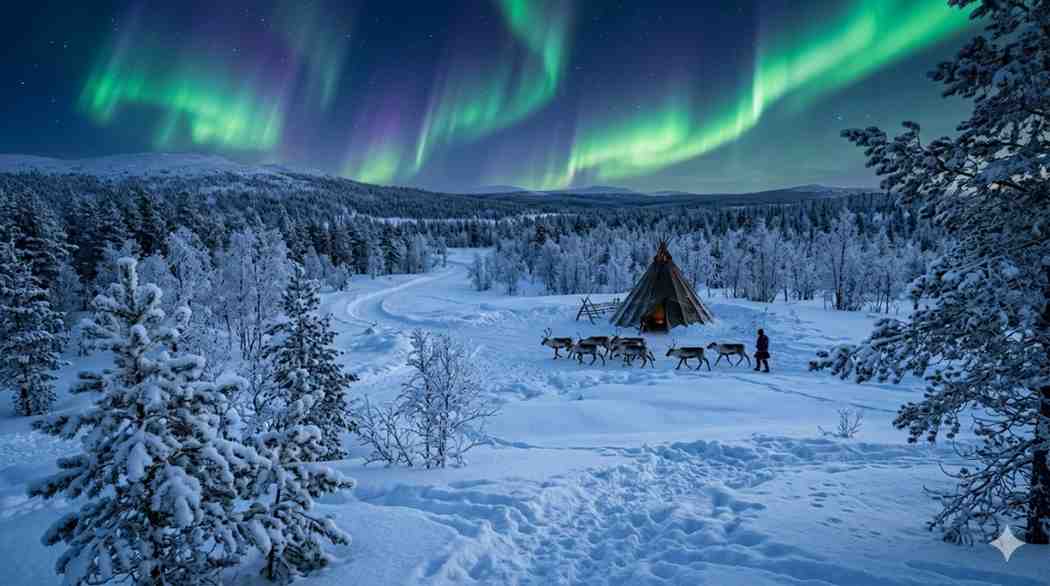
There are places in the world that dazzle with noise and spectacle. Then there is Lapland—a land that whispers.
Stretching across the northern reaches of Finland, Sweden, Norway, and parts of Russia, Lapland exists in a realm where nature speaks softly but profoundly. Here, silence is not emptiness. Snow is not merely weather. The sky itself becomes a storyteller, painting ancient legends across the horizon.
To travel through Lapland is to enter a different rhythm of life—one shaped not by clocks and calendars, but by seasons, light, and the enduring wisdom of the Arctic.
A Landscape Sculpted by Ice
At first glance, Lapland appears monochrome. Endless expanses of white cover frozen lakes, dense pine forests, and rolling fells that rise gently from the earth. Yet within this simplicity lies extraordinary beauty.
Snow softens every edge of the landscape. Footsteps disappear overnight beneath fresh powder. Rivers pause beneath layers of ice, and ancient spruce trees stand cloaked in frost like silent guardians of forgotten paths.
Winter here is not harshness alone; it is elegance.
The Arctic wilderness strips away distractions. Without the constant buzz of urban life, visitors begin to notice subtler details—the crunch of snow beneath boots, the distant call of a raven, the delicate patterns etched by frost onto cabin windows.
In Lapland, stillness sharpens awareness.
The Language of Silence
Silence in many places feels uncomfortable, something to be filled. In Lapland, silence becomes a presence of its own.
It settles over forests during snowfall. It stretches across frozen plains beneath pale winter sunlight. It accompanies sled rides through birch woods where only the breathing of huskies punctuates the air.
For the Indigenous Sámi people, who have inhabited these Arctic regions for thousands of years, the landscape has always held meaning beyond its physical form. Mountains, lakes, migration routes, and changing weather patterns are woven into stories passed from generation to generation.
Listening—to nature, to elders, and to silence itself—has long been a way of understanding the world.
Modern travelers often arrive seeking adventure. Many leave carrying something less tangible but equally transformative: the rare experience of quiet.
Beneath the Dancing Sky
As darkness settles over the Arctic winter, Lapland reveals one of its most enchanting wonders.
The Northern Lights.
Green ribbons ripple across the heavens, shifting and unfolding like celestial curtains stirred by an invisible wind. Sometimes they appear softly, barely brushing the stars. At other times, they ignite the night in brilliant waves of emerald, violet, and silver.
Science explains the phenomenon as charged particles from the sun colliding with Earth's atmosphere. Yet facts alone cannot capture the emotion of standing beneath an aurora-filled sky.
For centuries, Arctic communities crafted stories to explain these mysterious lights. Some believed they were the spirits of ancestors dancing overhead. Others regarded them with reverence and caution, treating the luminous display as a bridge between worlds.
Even today, many visitors find themselves speechless beneath the spectacle.
The sky becomes both theater and scripture—telling stories older than memory itself.
Seasons of Extremes
Life in Lapland unfolds through dramatic contrasts.
Winter brings the Polar Night, when the sun lingers below the horizon and daylight arrives as soft shades of blue and pink. Candlelit cabins glow against the darkness, inviting moments of warmth and reflection.
Then summer transforms the Arctic entirely.
The Midnight Sun bathes the landscape in continuous daylight. Wildflowers bloom across the tundra, rivers surge with melted snow, and reindeer roam beneath skies that never fully darken.
These shifting seasons remind us that nature is not static. It moves in cycles of rest and renewal, darkness and light.
Perhaps that is Lapland's greatest lesson: beauty often emerges through change.
Encounters with the Wild
Reindeer wander freely through forests and roadsides, embodying the spirit of the North. Arctic foxes leave delicate tracks across untouched snowfields. Moose move quietly among the trees, almost mythical in their presence.
Human life, too, reflects adaptation and resilience.
Traditional Sámi livelihoods such as reindeer herding continue alongside contemporary Arctic communities balancing heritage with modern realities. Their relationship with the environment illustrates a deep understanding of coexistence rather than conquest.
In Lapland, survival has always depended upon respect—for the land, for its creatures, and for the knowledge carried through generations.
The Stories We Carry Home
Travel often promises escape.
Lapland offers something different.
It invites return—not necessarily to a place, but to a state of being. It reminds us that wonder does not always arrive with grand declarations. Sometimes it drifts quietly through falling snow. Sometimes it glimmers in the hush of a frozen forest. Sometimes it dances above us in ribbons of Arctic light.
Long after travelers leave, they remember the silence.
They remember standing beneath an infinite sky, aware of both their smallness and their belonging within something vast and timeless.
The Arctic landscapes of Lapland do not demand attention.
They simply wait.
And for those willing to listen, the snow, the silence, and the sky continue to tell their ancient stories.